I acknowledge the Traditional Custodians of the ACT, the Ngunnawal people. I acknowledge and respect their continuing culture and the contribution they make to the life of this city and this region.
Showing posts with label reviews. Show all posts

Thursday, March 19, 2015

The Strays - an opinion

The StraysThe Strays by Emily Bitto
My rating: 4 of 5 stars


Publisher's blurb:
On her first day at a new school, Lily meets Eva, one of the daughters of the infamous avant-garde painter Evan Trentham. He and his wife are attempting to escape the stifling conservatism of 1930s Australia by inviting other like-minded artists to live and work with them at their family home. As Lily’s friendship with Eva grows, she becomes infatuated with this makeshift family and longs to truly be a part of it.

Looking back on those years later in life, Lily realises that this utopian circle involved the same themes as Evan Trentham’s art: Faustian bargains and terrible recompense; spectacular fortunes and falls from grace. Yet it was not Evan, nor the other artists he gathered around him, but his own daughters, who paid the debt that was owing.

This is more a response than a review.  I'm very tired this week and have not the patience or energy for a better structured or thought out review.


Emily Bitto's first novel is a well written  exploration of intense female childhood and adolescent friendship. A bit long through the middle; some editorial pruning would have helped.

This passage, for example, while it spoke to me and I was delighted to find it, was not really necessary for Lily's mother's character development.

For the information of knitters reading this - the following passge is the only reference to knitting.

p. 117

My mother began to knit again, a pale yellow jumper she was making for me.  We had picked out the pattern together; it was to have a pearl button at the neck and slightly puffed sleeves.  Over the following days my mother knitted almost without stopping: while she ate; while she talked to the nurses; while she sate by my father's bed.  She fell asleep knitting in the chair beside him, woke up, continued to knit.  She was like one of the fates, sullenly, determinedly knitting out the griefs of the world. Somehow my mother's anxiety, and my own, became entangled in the wool of that jumper, caught up in the purl of its weave so that it would always be tainted for me, as if it had absorbed the medicinal stink of the hospital, the image of my father, ashen, with his eyes closed, the thick sheets drawn up under his arms, the knobbly cotton blanket tight across his chest and over the bulky casts encasing both his legs, his toes protruding from the bedclothes so that their colour could be monitored - my mother and I had to fight the urge constantly to pull the blank over them to keep them warm.  I would never wear that cumper.


In the end I didn't really care about any of them. Particularly the cruelly manipulative Trenthams but not even very much about Lily.

Was going for 3 stars - really it's 3.5.


My 7th book for the Australian Women Writers' Challenge 2015.

Source: Libraries ACT

View all my reviews

Monday, March 16, 2015

Heat and Light - a review

Heat and LightHeat and Light by Ellen Van Neerven
My rating: 4 of 5 stars

Beyond knowing that it is shortlisted for the 2105 Stella Prize, I knew nothing of this work.

I deliberately didn't read the blurb or go looking for reviews.  I want to have as few preconceived notions about what I am about to read as possible.  I want to allow for the possibility of being surprised.

I was captivated on page one.

Structurally, this work of fiction is interesting.  It is not a novel.  It is divided into three sections, the first and the last being sets of short stories, the middle being a novella.

"Heat" is the first section and explores a single family from many points of view.  It is heat fanned by wind. Part fable, part imagined documentary; I enjoyed this section immensely.  The slow and unflinching unfolding of layers of family history was hugely satisfying.

The second section, "Water", is near future speculative fiction exploring issues of colonialism.  It is infused with a sense of historical de ja vu, and hasan urgent pace.

The third section, "Light", is the least optimistic of the three sections. There is truth here. The stories are not without emotion, but difficult themes of belonging and the desire to escape are explored without overt judgement.

Smoothly written and eminently readable, all of the stories show a steady, honest gaze.  Indigenous and queer voices should be heard more often. I look forward to reading more of van Neerven's work.

This is the sixth book read and reviewed for the Australian Women Writers' Challenge 2015. I have completed the challenge I set myself, but there are oh so many more to read.

View all my reviews on Goodreads

Source: LibrariesACT

Saturday, February 21, 2015

Madame Bovary's Haberdashery - a review

My rating: 4 of 5 stars
Funny, subversive, the point in the universe where Emma Bovary and Jane Marple intersect.

I was worried, at first, the author Meehan knew a little bit too much about how I spent my 20s - overweight knitter with a penchant for op shops in a co-dependent, not particularly healthy relationship with a promiscuous, artistic best friend.  Fortunately the similarities end there.

Everyone in this charming, engaging and darkly sly humourous novel is delusional, narcissistic, criminally manipulative, misogynistic, fraudulent or many of these in combination..

Odette, the beautiful free spirited potter who, "lurching unreflectingly from one style to the next, one man to the next, saw herself as living in wild freedom, just like any male artist" shares a house and a lover, Zac, with her friend Cicely.  Odette and Cicely have been best friends since primary school.  Their relationship is fractured by the manipulative, jealous and intellectually fraudulent Zac.

"Cicely has opinions, but she keeps them to herself".  Cicely has published a mildly successful erotic novel and keeps herself in tea and wool by creating knitted pieces to sell in Miss Ball's Haberdashery.  Cicely is overweight and suffers from hallucinations brought on by her failing vision and later by her dependence on pain medication.  It is through her hallucinations that Miss Marple assists Cicely solve the mystery of Odette's disappearance.

All of the male characters are unpleasant, misogynistic manipulators; while the women are competitive and manipulative.

I worry that Odette is returned to Cicely and is "redeemed" through murder and childbirth to, presumably, be held captive in Odette's dream haberdashery.  But perhaps that is the joke at the heart of the book.

While I enjoyed the novel (not least for the primary role of the fibre arts and the confirmation that crochet is evil, or at least created under hallucinogenics) I might have understood it better if I was more familiar with Flaubert's Madame Bovary.  I suspect I shall read it before long, even if it is written by the antithesis of an Australian woman.  I am better acquainted with Miss Marple and loved how Maurilia Meehan imagines her for Cicely.

I am also glad that Cicely achieves her dream of owning her own shop, the haberdashery of the title, and a room of her own.  But are we all such manipulators and are all our dreams realised at the expense of others?


SOURCE: Libraries ACT

Saturday, February 14, 2015

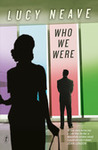
Who We Were by Lucy Neave - a review

Who We WereWho We Were by Lucy Neave
My rating: 4 of 5 stars


On finishing this book - my initial notes read:
Sparse and elegant prose but for a novel about passion and betrayal, strangely devoid of emotional connection.  I gave it 3 stars (out of 5)

Nearly a week later and I am back on Goodreads changing my score from 3 stars to 4.  I continue to think about this novel and divine why I couldn't connect.  I talk to friends and colleagues about it and wonder out loud to them why that was - should it have been a series of novellas to explore the effects of the political environments in which they find themselves and the significant issues such as scientific ethics, the effects of the Depression, WWII and the war in Asia in particular.

It's a very, very accomplished first novel.

I keep comparing Bill to Dorrigo from Flanagan's Narrow Road to the Deep North.  Similar experiences, similarly flawed but Bill just isn't sympathetic.

Also, the suspense which might have built in the Cold War period just didn't get there.

Perhaps I wasn't meant to connect.  Annabel and Bill save their passion for each other and their work, and in Bill's case, a political cause.  Annabel is a perpetual outsider, even in her marriage, and theirs is a very exclusive club so maybe I was meant to feel excluded.

I would recommend this book, but if you enjoy the emotional connection to character, you might not find it.  You will, however, have much food for thought.

This novel is shortlisted in the ACT Book of the Year Award.  For the first time this year you can vote in the People's Choice Awards, but get your skates on, voting closes soon.

For information on previous awards, a committed and passionate librarian has created this resource.

SOURCE: Libraries ACT

View all my reviews